
Henry Farrell
Guest on The Ezra Klein Show
Products they talk about
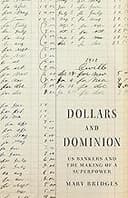
Dollars and Dominion👍 Recommends
…henry farrell recommending book on historical us hegemony building and lessons for today
“Okay, so I've got three books, one of which is directly connected to these questions. It's by a woman, a historian called Mary Bridges, called Dollars and Dominion. And so it is, on the one hand, it is not about what is happening right now. It is about what was happening in the beginning of the 1900s when the United States was trying to build up the kind of hegemony that we've talked about during the course of this show. And it is really about how the people who are trying to build it up look like some of the people who are acting now sort of in the twilight of this period. They are very self-interested. They're kind of venal. They're building on their political connections. And they also don't have much of a clue of what they are doing.”
on The Ezra Klein Show

Nonesuch👍 Recommends
…henry farrell recommending forthcoming fiction book about wartime economy and structure
“Second book is a book that's not available yet, but will be out in the United States, I think, in maybe two months. It's by Francis Spufford. It's called Nonesuch. So Spufford wrote this incredible book called Red Plenty, which really I and Abe took as one of our models for how do you write a book about complicated structures using individuals in order to tell the stories of how those structures work. This is a very different book in some ways. It's a fantasy set during the World War II blitz of London. But it's also a book about what is happening right now. And it's a book that has in some really interesting ways economic systems and how economic systems work, woven through the narrative in ways that you don't particularly notice, but you actually end up learning quite a lot.”
on The Ezra Klein Show
Private Truths, Public Lies💬 Mentioned
…discussing how authoritarian regimes sustain themselves through uncertainty and false appearance of consensus
“Okay, so the way in which I think about Havel's story is to introduce another academic. I'm a professor, so professors, I guess, have professional guild responsibilities. So it's a book by a guy called Timur Kuran, who's a somewhat conservative libertarian professor in Duke, called Private Truths, Public Lies. And so the argument more or less is you can think about political society and authoritarian regimes as being like a collective action problem, where if everybody knew how much the regime was hated, everybody could rise up against it.”
on The Ezra Klein Show
The Score👍 Recommends
…henry farrell recommending book about games and structures with deep philosophical insights
“And the final book is a book by Thi Nguyen, which has just come out called The Score. And it's just, you know, I don't even know how to begin to describe this book. It is about making pizza. It is about games. It is about the big structures that shape our lives and how they don't recognize the knowledge and the wonder and the intimacy that we have together. And it pulls together these disparate and many other disparate things into this incredibly compelling narrative. It is just a ridiculously beautiful book. We live in times when it's very easy to just feel unhappy and despairing. And I think that this is a book that brings back joy.”
on The Ezra Klein Show
Weapons of the Weak💬 Mentioned
…discussing how weaker countries resist hegemonic power projection through economic and military means
“I do think we're beginning to see some of that happening. The more that you use it as well, the less other countries are going to be willing to buy into the stuff that you offer. And I think one of the really interesting test cases that is coming up is AI because if you look at the political economy of AI, the Trump administration's approach to AI seems to be to offer it as freely and widely as possible in the expectation that everybody is going to be so impressed with the ways in which US AI companies have powered ahead that they will have no choice but to become dependent upon it. And then presumably after that, at some point, the US is able to use this as a new means of power. It is effectively in control of another of the great infrastructures of the world. And I'm going to be really interested to see whether countries actually, I'm sure, shrug their shoulders and go for it or whether or not they decide that actually it makes better sense for them to build their own platforms even if these platforms are worse because at least these platforms are theirs and cannot be used against them. And they begin to resist in different ways. I do think we're beginning to see some of that happening. The more that you use it as well, the less other countries are going to be willing to buy into the stuff that you offer. And I think one of the really interesting test cases that is coming up is AI because if you look at the political economy of AI, the Trump administration's approach to AI seems to be to offer it as freely and widely as possible in the expectation that everybody is going to be so impressed with the ways in which US AI companies have powered ahead that they will have no choice but to become dependent upon it. And then presumably after that, at some point, the US is able to use this as a new means of power. It is effectively in control of another of the great infrastructures of the world. And I'm going to be really interested to see whether countries actually, I'm sure, shrug their shoulders and go for it or whether or not they decide that actually it makes better sense for them to build their own platforms even if these platforms are worse because at least these platforms are theirs and cannot be used against them. Because the more that you do this, the more that other countries begin to try and figure out ways to use what the late political scientist James Scott calls the weapons of the weak. So they begin to resist in different ways.”
on The Ezra Klein Show